The Loeb blurb comments, "and Tryphiodorus (papyri reveal the correct spelling to be “Triphiodorus”) deals with The Taking of Troy in 691 lines, beginning with the Wooden Horse and ending with the sacrifice of Polyxena.".
These papyri cannot be the one from Oxyrhynchus, P.Oxy. XLI 2946. The evidence of the documentary papyri can be assembled through Trismegistos People.
If the first member is τριφι-ο-, the Graeco-Egyptian deity Triphis is involved in a name with a geographically restricted distribution.
Lexical studies (Italian).
M.L. West wrote in Gnomon 42.7 (1970), 657-661 at 661, of Livrea's edition of Colluthus: 'I hope that Livrea will persevere with his edition of Triphiodorus ; that he will give it a more comprehensive introduction, a less constipated apparatus, and a better-balanced commentary; and that he will stop spelling the poet's name with a y.'.
LGPN knows no bearers of this name at this date of either spelling.
Showing posts with label Poems. Show all posts
Showing posts with label Poems. Show all posts
Monday, 20 June 2016


Wednesday, 11 May 2016
patrii sermonis egestas
So Lucretius 1.832 and 3.260. Horace, Ars Poetica, also addressed this point and others of lexical interest (ll. 47-72).
Words and meanings come and go. Cf. too 'The missing plays of Sophocles will turn up piece by piece, or be written in another language. Ancient cures for diseases will reveal themselves once more. Mathematical discoveries glimpsed and lost to view will have their time again.' -- Tom Stoppard, Arcadia.
'The best words in the best order', as my English teacher used to quote.
Other notes from the AP shall follow. For now, there is the plural of the personal name Piso (ll. 6 and 235, in reference to the father and his sons) and of the toponym Anticyra (ll. 299-301): nanciscetur enim pretium nomenque poetae, | si tribus Anticyris caput insanabile numquam | tonsori Licino commiserit (Loeb: 'for surely one will win the esteem and name of poet if he never entrusts to the barber Licinus a head that three Anticyras cannot cure'). Cf. Persius 4.16.
dixeris egregie, notum si callida verbum
reddiderit iunctura novum. si forte necesse est
indiciis monstrare recentibus abdita rerum et
fingere cinctutis non exaudita Cethegis,
continget dabiturque licentia sumpta pudenter,
et nova fictaque nuper habebunt verba fidem, si
Graeco fonte cadent parce detorta. quid autem
Caecilio Plautoque dabit Romanus ademptum
Vergilio Varioque? ego cur, adquirere pauca
si possum, invideor, cum lingua Catonis et Enni
sermonem patrium ditaverit et nova rerum
nomina protulerit? licuit semperque licebit
signatum praesente nota producere nomen.
ut silvae foliis pronos mutantur in annos,
prima cadunt: ita verborum vetus interit aetas,
et iuvenum ritu florent modo nata vigentque.
debemur morti nos nostraque: sive receptus
terra Neptunus classes Aquilonibus arcet,
regis opus, sterilisve diu palus aptaque remis
vicinas urbes alit et grave sentit aratrum,
seu cursum mutavit iniquum frugibus amnis
doctus iter melius: mortalia facta peribunt,
nedum sermonum stet honos et gratia vivax.
multa renascentur quae iam cecidere cadentque
quae nunc sunt in honore vocabula, si volet usus,
quem penes arbitrium est et ius et norma loquendi.
Words and meanings come and go. Cf. too 'The missing plays of Sophocles will turn up piece by piece, or be written in another language. Ancient cures for diseases will reveal themselves once more. Mathematical discoveries glimpsed and lost to view will have their time again.' -- Tom Stoppard, Arcadia.
'The best words in the best order', as my English teacher used to quote.
Other notes from the AP shall follow. For now, there is the plural of the personal name Piso (ll. 6 and 235, in reference to the father and his sons) and of the toponym Anticyra (ll. 299-301): nanciscetur enim pretium nomenque poetae, | si tribus Anticyris caput insanabile numquam | tonsori Licino commiserit (Loeb: 'for surely one will win the esteem and name of poet if he never entrusts to the barber Licinus a head that three Anticyras cannot cure'). Cf. Persius 4.16.
Monday, 28 September 2015
Anacreon in epigraphy
In the nom.sg. and in oblique cases, not all of which are the Anacreon of Teos (LGPN knows six bearers of the name).
The Autun Mosaic contains fr. 396 and 429 PMG. Some coins have images online.
The Autun Mosaic contains fr. 396 and 429 PMG. Some coins have images online.
Friday, 18 September 2015
The Bacchylides papyrus
A telling of the acquisition of this treasure can be found in:
A. P. Burnett, The Art of Bacchylides (Martin Classical Lectures: vol. 29). Cambridge, MA.: Harvard University Press, 1985), pp. 1-2, where division into some 200 pieces is mentioned.
A. P. Burnett, The Art of Bacchylides (Martin Classical Lectures: vol. 29). Cambridge, MA.: Harvard University Press, 1985), pp. 1-2, where division into some 200 pieces is mentioned.
Monday, 27 July 2015
A Laconian hexameter and elegiac inscriptions
CEG 373 (525 BCE) IG V, 1 919 (an elegiac couplet) is from Sellasia in Laconia.
Note Διοσκο̄́ροισιν (nisi divisim?) with -οισι and-ν under epic influence.
It seems that (-)κο̄́ρ- stands for Ionic κούρ-, as in epic (cf. too CEG 391 550-525 BCE Cephallonia and CEG 427 6th-c. BCE Cnidos). Theoc.15.120 shows κῶρος, which, in the absence of evidence for omega in this inscription, would be written with omicron, just as in Διοσκο̄́ροισιν here. Cf. the middle column of Buck 1955: § 51 (for Ionic and the 'Doric' of Argolis, Crete, Thera, Cos, Rhodes, and colonies in contrast to dialects that preserved post-consonantl digamma and those, like Attic, in which the vowel was not affected).
SEG XLVI 400 (= Colvin, no. 34; see also SEG L 394 and LVII 353 on the division and identity of ΚΑΛΗ) was found as recently 1988.
Note Διοσκο̄́ροισιν (nisi divisim?) with -οισι and-ν under epic influence.
It seems that (-)κο̄́ρ- stands for Ionic κούρ-, as in epic (cf. too CEG 391 550-525 BCE Cephallonia and CEG 427 6th-c. BCE Cnidos). Theoc.15.120 shows κῶρος, which, in the absence of evidence for omega in this inscription, would be written with omicron, just as in Διοσκο̄́ροισιν here. Cf. the middle column of Buck 1955: § 51 (for Ionic and the 'Doric' of Argolis, Crete, Thera, Cos, Rhodes, and colonies in contrast to dialects that preserved post-consonantl digamma and those, like Attic, in which the vowel was not affected).
SEG XLVI 400 (= Colvin, no. 34; see also SEG L 394 and LVII 353 on the division and identity of ΚΑΛΗ) was found as recently 1988.
Monday, 29 June 2015
Notes on Euboean inscriptions: Nestor's Cup... et al.
IGASMG III 2 presents a very diplomatic edition of this very famous and much discussed inscription (discovered in 1954). Colvin, no. 25 is less conservative. Other restorations have been proposed by Calvert Watkins and P.A. Hansen. Anne Jeffery's notes are online.
Colvin notes that ποτήριον is not a Homeric word, but survives into Modern Greek as ποτήρι. Its place in Modern Greek follows its place in the Koine (e.g. 1 Corinthians 11: 25 f.), but it is found as early as Sappho (44.10) and Alcaeus 376 and in early Attic epigraphy (e.g. IG I^3 292 ποτέ̄ρια ἀργυρᾶ). In Athenaeus 11.460b, Semonides of Amorgos is said to have been the first to use it (the corrupt iambic quotation is fragment 26 West). The noun also appears in Latin. Plautus has poterium twice (at least): Stich. 694 and Trin. 1017.
As a name, Nestor has some historical currency.
There is also the seventh-century maker's mark of Pyrrhos, for once an early name that is not rare, on an aryballos (so LSAG 88.22, but Buck, no. 9 'lecythus').
The digamma is absent in ἐποίε̄σεν, but present in Ἀγασίλε̄ϝος (< λᾱϝός), who is Ἀγασίλεως in LGPN I (cf. Ἀγασίληϝος).
Colvin notes that ποτήριον is not a Homeric word, but survives into Modern Greek as ποτήρι. Its place in Modern Greek follows its place in the Koine (e.g. 1 Corinthians 11: 25 f.), but it is found as early as Sappho (44.10) and Alcaeus 376 and in early Attic epigraphy (e.g. IG I^3 292 ποτέ̄ρια ἀργυρᾶ). In Athenaeus 11.460b, Semonides of Amorgos is said to have been the first to use it (the corrupt iambic quotation is fragment 26 West). The noun also appears in Latin. Plautus has poterium twice (at least): Stich. 694 and Trin. 1017.
As a name, Nestor has some historical currency.
There is also the seventh-century maker's mark of Pyrrhos, for once an early name that is not rare, on an aryballos (so LSAG 88.22, but Buck, no. 9 'lecythus').
The digamma is absent in ἐποίε̄σεν, but present in Ἀγασίλε̄ϝος (< λᾱϝός), who is Ἀγασίλεως in LGPN I (cf. Ἀγασίληϝος).
Thursday, 11 June 2015
Hermippos Comikos and catalogues of flowers
Fragment 82 Kock concerns various wines:
Μενδαῖον, τοῦ μὲν καὶ ἐνουροῦσιν θεοὶ αὐτοὶ
στρώμασιν ἐν μαλακοῖς. Μάγνητα δὲ μειλιχόδωρον
καὶ Θάσιον, τῷ δὴ μήλων ἐπιδέδρομεν ὀδμή,
ταῦτον ἐγὼ κρίνω πολὺ πάντων εἶναι ἄριστον
τῶν ἄλλων οἴνων, μετ’ ἀμύμονα Χῖον ἄλυπον.
ἔστι δέ τις οἶνος, τὸν δὴ σαπρίαν καλέουσιν,
οὗ καὶ ἀπὸ στόματος στάμνων ὑπανοιγομενάων
ὄζει ἴων, ὄζει δὲ ῥόδων, ὄζει δ’ ὑακίνθου.
ὀσμὴ θεσπεσίη κατὰ πᾶν δ’ ἔχει ὑψερεφὲς δῶ.
ἀμβροσία καὶ νέκταρ ὁμοῦ τοῦτ’ ἐστὶ τὸ νέκταρ.
τούτου χρὴ παρέχειν πίνειν ἐν δαιτὶ θαλείῃ
τοῖσιν ἐμοῖσι φίλοις, τοῖς δ’ ἐχθροῖς ἐκ Πεπαρήθου.
For other flower catalogues, see: GVI 1409, IG XIV 607 e.1-10 (Hadrianic(?), a multipart bilingual), Il.14.346-351, Cypria fr. 4, Sapph.94.12-17, 96.12-14, hHom.2.6-8, 2.425-8, 19.23-26, Theoc.1.132-4, and Mosch.2.64-66.
Μενδαῖον, τοῦ μὲν καὶ ἐνουροῦσιν θεοὶ αὐτοὶ
στρώμασιν ἐν μαλακοῖς. Μάγνητα δὲ μειλιχόδωρον
καὶ Θάσιον, τῷ δὴ μήλων ἐπιδέδρομεν ὀδμή,
ταῦτον ἐγὼ κρίνω πολὺ πάντων εἶναι ἄριστον
τῶν ἄλλων οἴνων, μετ’ ἀμύμονα Χῖον ἄλυπον.
ἔστι δέ τις οἶνος, τὸν δὴ σαπρίαν καλέουσιν,
οὗ καὶ ἀπὸ στόματος στάμνων ὑπανοιγομενάων
ὄζει ἴων, ὄζει δὲ ῥόδων, ὄζει δ’ ὑακίνθου.
ὀσμὴ θεσπεσίη κατὰ πᾶν δ’ ἔχει ὑψερεφὲς δῶ.
ἀμβροσία καὶ νέκταρ ὁμοῦ τοῦτ’ ἐστὶ τὸ νέκταρ.
τούτου χρὴ παρέχειν πίνειν ἐν δαιτὶ θαλείῃ
τοῖσιν ἐμοῖσι φίλοις, τοῖς δ’ ἐχθροῖς ἐκ Πεπαρήθου.
For other flower catalogues, see: GVI 1409, IG XIV 607 e.1-10 (Hadrianic(?), a multipart bilingual), Il.14.346-351, Cypria fr. 4, Sapph.94.12-17, 96.12-14, hHom.2.6-8, 2.425-8, 19.23-26, Theoc.1.132-4, and Mosch.2.64-66.
Tuesday, 12 May 2015
Artificial lexemes
Callimachus (Hecale 275 Pfeiffer = 52 Hollis) has ἄστηνος (cf. δύστηνος), which is otherwise only found in GVI 633 (mid. 1st c. BCE).
Cf. στήτᾱ thought to have arisen from Il.1.6. Callimachus also has ἀπούατος (Hecale 315 Pfeiffer = 122 Hollis), which is not in LSJ. The Suppl. gives ill–sounding, ill–omened. For its origins, cf. Il.18.272.
Cf. στήτᾱ thought to have arisen from Il.1.6. Callimachus also has ἀπούατος (Hecale 315 Pfeiffer = 122 Hollis), which is not in LSJ. The Suppl. gives ill–sounding, ill–omened. For its origins, cf. Il.18.272.
Thursday, 16 April 2015
An Alcaeus papyrus
The papyrus that preserves S262 (= 298 Voight & Campbell's Loeb; Campbell, Greek Lyric Poetry, pp. 465-466) has a bibliography and can be viewed in colour.
The papyrus shows fluctuation in accentual practice: ἔπηπον 11, but κατῆχε 15. Campbell reproduces this. Page, OCT, p. 76, gives κάτηχε. Note the grave accents on syllables that are unaccented in our texts.
Examples of alpha marked with a breve or with a macron can be seen in lines 16 and 17: ὀλόᾱν / ... Πάλλᾰδας ἄ̄ θέων.
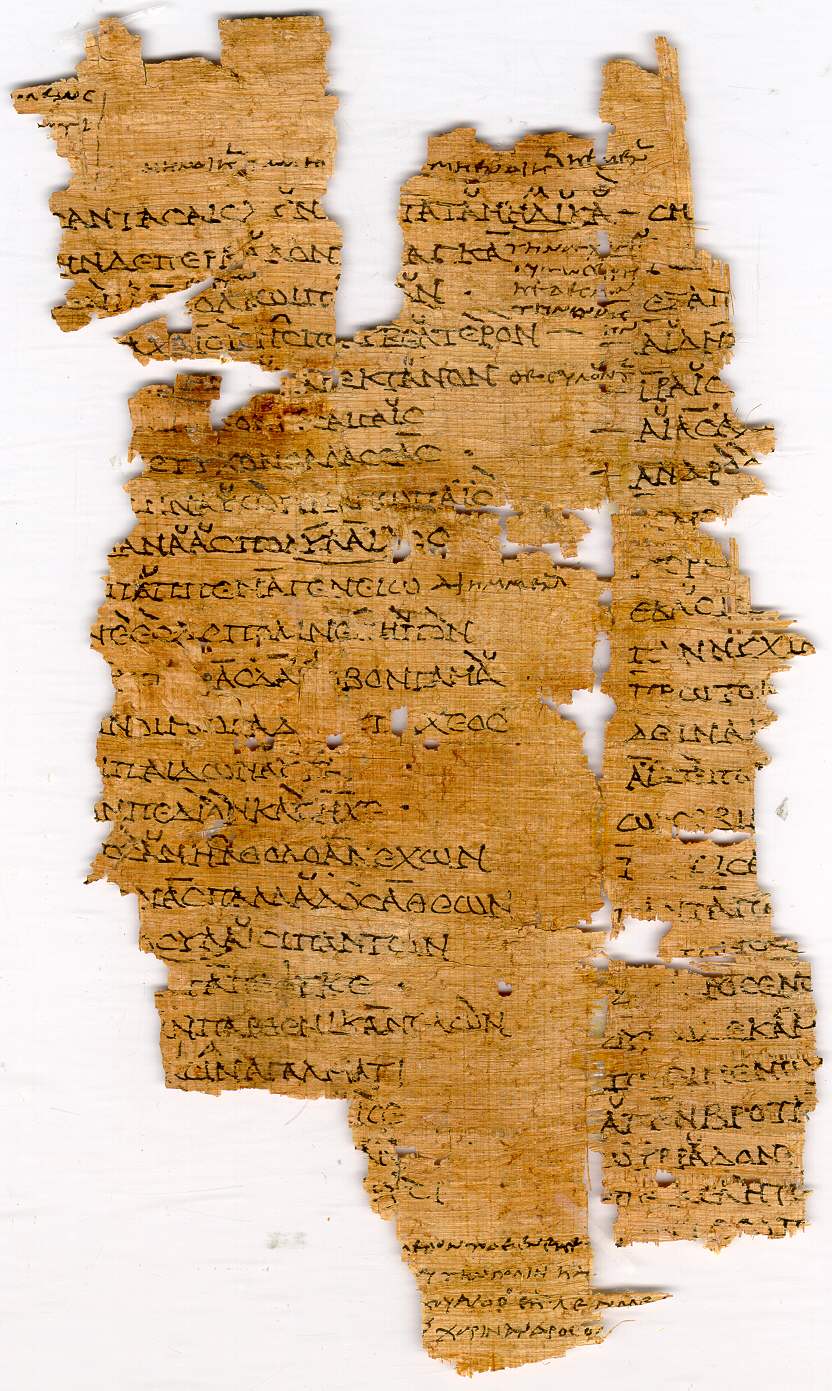
The papyrus shows fluctuation in accentual practice: ἔπηπον 11, but κατῆχε 15. Campbell reproduces this. Page, OCT, p. 76, gives κάτηχε. Note the grave accents on syllables that are unaccented in our texts.
Examples of alpha marked with a breve or with a macron can be seen in lines 16 and 17: ὀλόᾱν / ... Πάλλᾰδας ἄ̄ θέων.
Thursday, 26 February 2015
A epigraphic paragraphos in the wild ?
D.L. Page ad PMG 932.10-11 notes 'paragraphus incisa'. Here is said mark: (upclose beneath δὲ in the middle line)

(in context in the penultimate line)

οἶ]δε παθὼν | καὶ χώρα Ἀχαιμενιδᾶν μεγαλαύχων. (so Campbell).
Wikipedia has some neat examples of the coronis in papyri, but not so much, at present on the paragraphos.
(in context in the penultimate line)
Wikipedia has some neat examples of the coronis in papyri, but not so much, at present on the paragraphos.
Wednesday, 28 January 2015
The <I> in Ibycus
The quantity of the <I> in this poet's name is evident in a Latin source, Statius, Silvae V.3.153 (in context):
Hinc tibi vota patrum credi generosaque pubes
te monitore regi, mores et facta priorum
discere, quis casus Troiae, quam tardus Vlixes,
quantus equum pugnasque virum decurrere versu
Maeonides quantumque pios ditarit agrestes 150
Ascraeus Siculusque senex, qua lege recurrat
Pindaricae vox flexa lyrae volucrumque precator
Ibycus et tetricis Alcman cantatus Amyclis
Stesichorusque ferox saltusque ingressa viriles
non formidata temeraria Chalcide Sappho, 155
quosque alios dignata chelys.
OLD s.v. Ibycus: 'A Greek poet of Rhegium,
of the 6th century B.C., whose murder was
witnessed and revealed by cranes.
Cic.Tusc.4.71; uolucrum... precator ~us STAT.Silv.5.3.153.'
Hinc tibi vota patrum credi generosaque pubes
te monitore regi, mores et facta priorum
discere, quis casus Troiae, quam tardus Vlixes,
quantus equum pugnasque virum decurrere versu
Maeonides quantumque pios ditarit agrestes 150
Ascraeus Siculusque senex, qua lege recurrat
Pindaricae vox flexa lyrae volucrumque precator
Ibycus et tetricis Alcman cantatus Amyclis
Stesichorusque ferox saltusque ingressa viriles
non formidata temeraria Chalcide Sappho, 155
quosque alios dignata chelys.
OLD s.v. Ibycus: 'A Greek poet of Rhegium,
of the 6th century B.C., whose murder was
witnessed and revealed by cranes.
Cic.Tusc.4.71; uolucrum... precator ~us STAT.Silv.5.3.153.'
Monday, 19 January 2015
The Latin 3pl.pf. indicative
L.R. Palmer, The Latin Language, 1954, p. 275:
(1) *-is-ont >-ĕrunt;
(2) stative -ē- + -ri > -ēre;
(3) a contamination of the two types > -ērunt.
Examples:
(1) matri longa decem tulĕrunt fastidia menses. Virgil, Eclogue IV.61.
(2) urbem Romam a principio reges habuēre. Tacitus, Annales I.1.1
(3) Postquam te fata tulērunt,
ipsa Pales agros atque ipse reliquit Apollo. Virgil, Eclogue V.34-5.
(1) *-is-ont >-ĕrunt;
(2) stative -ē- + -ri > -ēre;
(3) a contamination of the two types > -ērunt.
Examples:
(1) matri longa decem tulĕrunt fastidia menses. Virgil, Eclogue IV.61.
(2) urbem Romam a principio reges habuēre. Tacitus, Annales I.1.1
(3) Postquam te fata tulērunt,
ipsa Pales agros atque ipse reliquit Apollo. Virgil, Eclogue V.34-5.
Wednesday, 14 January 2015
'Tmesis' in Ennius
Skutsch, Annales 14.376-7 (unless prep. super + undas, a 'most unusual' word order):
Labitur uncta carina, uolat super impetus undas
Verrunt extemplo placidum mare:
Cic.carm. 22.15 M, Virg.Aen.6.254, and Virg.Ecl.6.81 (= Cir. 51) are cited (p. 542) for comparison.
Skutsch, fragmenta spuria v and vi:
(from Servius on Aeneid 1.412 circum se fudit, also citing Georg.3.381 septem subiecta trioni): saxo cere comminuit brum.'
The B and T scholia to Iliad 17.522 and 542 are mentioned (p. 788), where 'attention is drawn to Anacr.95 D. (80 B.) = 441 PMG.
This second instance is discussed by Palmer (1954: 101), who also cites de me hortatur 'he dissuades me' (= Skutsch 13.371-2
Hannibal audaci cum pectore de me hortatur
Ne bellum faciam,... ).
Labitur uncta carina, uolat super impetus undas
Verrunt extemplo placidum mare:
Cic.carm. 22.15 M, Virg.Aen.6.254, and Virg.Ecl.6.81 (= Cir. 51) are cited (p. 542) for comparison.
Skutsch, fragmenta spuria v and vi:
(from Servius on Aeneid 1.412 circum se fudit, also citing Georg.3.381 septem subiecta trioni): saxo cere comminuit brum.'
The B and T scholia to Iliad 17.522 and 542 are mentioned (p. 788), where 'attention is drawn to Anacr.95 D. (80 B.) = 441 PMG.
This second instance is discussed by Palmer (1954: 101), who also cites de me hortatur 'he dissuades me' (= Skutsch 13.371-2
Hannibal audaci cum pectore de me hortatur
Ne bellum faciam,... ).
Friday, 8 August 2014
The other Gallus fragment and assessments of authors
Gallus, Epigrammata 1 (dactylic pentameter):
(Vib.Sec. 77) Hypanis Scythiae, qui ut ait Gallus
uno tellures dividit amne duas(.)
Asiam enim ab Europa separat.
Cicero, Orator 62:
Quamquam enim et philosophi quidam ornate locuti sunt—si quidem et Theophrastus a divinitate loquendi nomen invenit et Aristoteles Isocratem ipsum lacessivit et Xenophontis voce Musas quasi locutas ferunt et longe omnium quicumque scripserunt aut locuti sunt exstitit et suavitate et gravitate princeps Plato—, tamen horum oratio neque nervos neque aculeos oratorios ac forensis habet.
Certain philosophers, to be sure, had an ornate style,--for example Theophrastus received his name from his divinely beautiful language, and Aristotle challenged even Isocrates, and the Muses were said to speak with the voice of Xenophon, and Plato was, in dignity and grace easily the first of all writers or speakers--yet their style lacks the vigour and sting necessary for oratorical efforts in public life. (Loeb)
Diogenes Laertius V.38 reports that Theophrastus was renamed by Aristotle from Tyrtamus (the sole bearer of this name in LGPN).
Statius, Silvae V.3.146-161:
Hinc tibi vota patrum credi generosaque pubes
te monitore regi, mores et facta priorum
discere, quis casus Troiae, quam tardus Vlixes,
quantus equum pugnasque virum decurrere versu
Maeonides quantumque pios ditarit agrestes 150
Ascraeus Siculusque senex, qua lege recurrat
Pindaricae vox flexa lyrae volucrumque precator
Ibycus et tetricis Alcman cantatus Amyclis
Stesichorusque ferox saltusque ingressa viriles
non formidata temeraria Chalcide Sappho, 155
quosque alios dignata chelys. tu pandere doctus
carmina Battiadae latebrasque Lycophronis atri
Sophronaque implicitum tenuisque arcana Corinnae.
sed quid parva loquor? tu par assuetus Homero
ferre iugum senosque pedes aequare solutis 160
versibus et numquam passu breviore relinqui.
(Vib.Sec. 77) Hypanis Scythiae, qui ut ait Gallus
uno tellures dividit amne duas(.)
Asiam enim ab Europa separat.
Cicero, Orator 62:
Quamquam enim et philosophi quidam ornate locuti sunt—si quidem et Theophrastus a divinitate loquendi nomen invenit et Aristoteles Isocratem ipsum lacessivit et Xenophontis voce Musas quasi locutas ferunt et longe omnium quicumque scripserunt aut locuti sunt exstitit et suavitate et gravitate princeps Plato—, tamen horum oratio neque nervos neque aculeos oratorios ac forensis habet.
Certain philosophers, to be sure, had an ornate style,--for example Theophrastus received his name from his divinely beautiful language, and Aristotle challenged even Isocrates, and the Muses were said to speak with the voice of Xenophon, and Plato was, in dignity and grace easily the first of all writers or speakers--yet their style lacks the vigour and sting necessary for oratorical efforts in public life. (Loeb)
Diogenes Laertius V.38 reports that Theophrastus was renamed by Aristotle from Tyrtamus (the sole bearer of this name in LGPN).
Statius, Silvae V.3.146-161:
Hinc tibi vota patrum credi generosaque pubes
te monitore regi, mores et facta priorum
discere, quis casus Troiae, quam tardus Vlixes,
quantus equum pugnasque virum decurrere versu
Maeonides quantumque pios ditarit agrestes 150
Ascraeus Siculusque senex, qua lege recurrat
Pindaricae vox flexa lyrae volucrumque precator
Ibycus et tetricis Alcman cantatus Amyclis
Stesichorusque ferox saltusque ingressa viriles
non formidata temeraria Chalcide Sappho, 155
quosque alios dignata chelys. tu pandere doctus
carmina Battiadae latebrasque Lycophronis atri
Sophronaque implicitum tenuisque arcana Corinnae.
sed quid parva loquor? tu par assuetus Homero
ferre iugum senosque pedes aequare solutis 160
versibus et numquam passu breviore relinqui.
Wednesday, 6 June 2012
More calendar poetry
Goodbye, No use leading with our chins,
This is where our story ends,
Never lovers, ever friends.
Goodbye, Let our hearts call it a day,
But before you walk away,
I sincerely want to say:
I wish you bluebirds in the Spring,
To give your heart a song to sing;
And then a kiss, but more than this I wish you love.
And in July, a lemonade,
To cool you in some leafy glade;
I wish you health and more than wealth, I wish you love.
My breaking heart and I agree
That you and I could never be,
So with my best, my very best, I set you free.
I wish you shelter from the storm,
A cozy fire to keep you warm;
But most of all, when snowflakes fall,
I wish you love.
Frank Sinatra, "I wish you love".
This is where our story ends,
Never lovers, ever friends.
Goodbye, Let our hearts call it a day,
But before you walk away,
I sincerely want to say:
I wish you bluebirds in the Spring,
To give your heart a song to sing;
And then a kiss, but more than this I wish you love.
And in July, a lemonade,
To cool you in some leafy glade;
I wish you health and more than wealth, I wish you love.
My breaking heart and I agree
That you and I could never be,
So with my best, my very best, I set you free.
I wish you shelter from the storm,
A cozy fire to keep you warm;
But most of all, when snowflakes fall,
I wish you love.
Frank Sinatra, "I wish you love".
Wednesday, 7 September 2011
Trilingualism
Meleager, Anth. 7.419 [= GP IV, 4000 ff., OCT IV, 4044 ff., Penguin no. 289 (Peter Whigham)]
Ἀτρέμας, ὦ ξένε, βαῖνε· παρ’ εὐσεβέσιν γὰρ ὁ πρέσβυς
εὕδει κοιμηθεὶς ὕπνον ὀφειλόμενον,
Εὐκράτεω Μελέαγρος, ὁ τὸν γλυκύδακρυν Ἔρωτα
καὶ Μούσας ἱλαραῖς συστολίσας Χάρισιν·
ὃν θεόπαις ἤνδρωσε Τύρος Γαδάρων θ’ ἱερὰ χθών·
Κῶς δ’ ἐρατὴ Μερόπων πρέσβυν ἐγηροτρόφει.
ἀλλ’ εἰ μὲν Σύρος ἐσσί, „Σαλάμ“, εἰ δ’ οὖν σύ γε Φοῖνιξ,
„Αὐδονίς“, εἰ δ’ Ἕλλην, „Χαῖρε“, τὸ δ’ αὐτὸ φράσον.
Friday, 22 July 2011
Carl Sandburg on Poetry
Is Sandburg's assessment "poetry is the synthesis of hyacinths and biscuits" fair in relation to Hellenistic poetry, tragedy, lyric or Homer?
Wednesday, 13 July 2011
From The Greek Anthology: Perfume, Scholarship, Adynata
"You are the perfume of your perfume."
(loosely) Adespoton, Anth. 5.91
Philip of Thessalonika:
Χαίροιθ’, οἱ περὶ κόσμον ἀεὶ πεπλανηκότες ὄμμα
οἵ τ’ ἀπ’ Ἀριστάρχου σῆτες ἀκανθολόγοι.
ποῖ γὰρ ἐμοὶ ζητεῖν, τίνας ἔδραμεν Ἥλιος οἴμους
καὶ τίνος ἦν Πρωτεὺς καὶ τίς ὁ Πυγμαλίων;
γινώσκοιμ’, ὅσα λευκὸν ἔχει στίχον· ἡ δὲ μέλαινα
ἱστορίη τήκοι τοὺς Περικαλλιμάχους. A long farewell to your universe-swivelling optics,
and to all your Aristarchoid acanthologizing bookworms!
What do I care about aphelion or perihelion,
or the generations of Proteus or Pygmalion?
Clarity, clarity always! and may some tenebrous saga
wither the bones of the Hypercallimachoids!
Anth. 11.347 [Translated by Edwin Morgan as no. 474 in Peter Jay's Penguin]
Γραμματικοὶ Μώμου στυγίου τέκνα, σῆτες ἀκανθῶν,
τελχῖνες βίβλων, Ζηνοδότου σκύλακες,
Καλλιμάχου στρατιῶται, ὃν ὡς ὅπλον ἐκτανύσαντες,
οὐδ’ αὐτοῦ κείνου γλῶσσαν ἀποστρέφετε,
εὔαδε καὶ ζητεῖν, εἰ κύνας εἶχε Κύκλωψ,
τρίβοισθ’ εἰς αἰῶνα κατατρύζοντες ἀλιτροὶ
ἄλλων· ἐς δ’ ἡμᾶς ἰὸν ἀποσβέσατεAnth. 11.321.
**
Οὐρανὸς ἄστρα τάχιον ἀποσβέσει ἢ τάχα νυκτὸς
ἠέλιος φαιδρὴν ὄψιν ἀπεργάσεται
καὶ γλυκὺ νᾶμα θάλασσα βροτοῖς ἀρυτήσιμον ἕξει
καὶ νέκυς εἰς ζωῶν χῶρον ἀναδράμεται,
ἤ ποτε Μαιονίδαο βαθυκλεὲς οὔνομ’ Ὁμήρου
λήθη γηραλέων ἁρπάσεται σελίδων. The sky will estinguish its stars, and the sun
will appear shining in the folds of night,
and the seawill be a well of fresh water for men,
and the dead will come back to the land of the living,
before forgetfulness of those ancient lines
can steal from us the far-famed name of Homer.
Anth. 9.575 [Translated by Edwin Morgan as no. 472 in Peter Jay's Penguin]
Thursday, 7 April 2011
Thursday, 20 August 2009
Translations: Martial, Sappho, Ovid
Some translations of one of my favourite pieces of Latin poetry have been blogged and then blogged further.
While we are on the subject of translations, there is Martin West's rendition of the "new" Sappho, The Times Stephen Spender Prize winner for 2008 for Ovid's Amores 1.1, and Christopher Marlowe's version of Ovid's Amores 1.5.
Subscribe to:
Posts (Atom)